
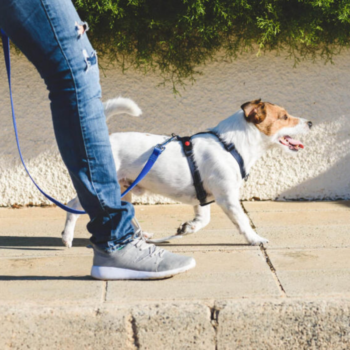
There are several reasons why animal keeper wish to equip themselves with a harness for their dog;
- To follow the advice of a canine worker, in order to properly train their dog for walking;
- To have a better control over your dog during outdoor outings;
- For his safety during car rides;
- To comply with the provincial regulation on the supervision of dogs, which requires guardians of dogs over 20kg to wear a harness or halter attached to the leash during outdoor outings.
But as you arrive in a pet shop, you will quickly realize that a variety of models exist! How to make the right choice for you and your dog? Our canine behavior intervene at the SPA de l’Estrie, Philipe Thyrion, gives you some advice and explanations to know what to look for and consider when making your purchase.
HALTER
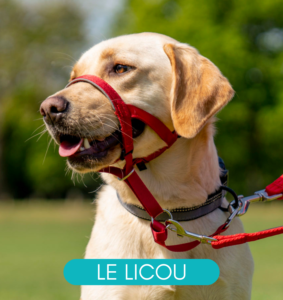 As you can see in the picture, the halter is composed of a band of soft fabric and surrounds the dog’s snout, then ties around the neck. Although the shape resembles that of a muzzle, this is not the case at all! The dog wearing a halter can drink, eat and bark without any problem. The leash, on the other hand, comes to be attached below your dog’s neck.
It is preferable to use the halter on a dog that has a very good self-control. It’s the same thing for the caretaker at the end of the leash, he must be very calm when walking his dog. It is essential to avoid sudden movements (blows in the leash), as this may cause significant cervical lesions. Indeed, when a dog wears a halter, and you pull its leash, its head suddenly turns towards you. If the blow is too strong and the dog resists, it can injure its neck.
Moreover, depending on your dog’s morphology, the halter is simply not possible. For example, flat-nosed dogs (brachycephalic dogs; Boston Terrier, Shih Tzu, etc.), do not have the morphology to be able to wear a halter.
At the adjustement level, make sure that the halter does not tighten the dog’s snout and do not hinder its vision.
HARNESS
First of all, know that there are several types of dog harnesses on the market
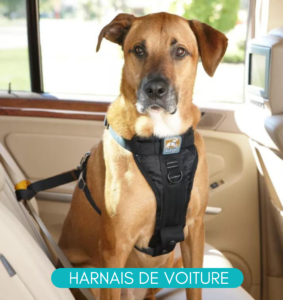
- The harness for the car: normally presents a good padding at the level of the animal’s chest and has attachment points on its back.
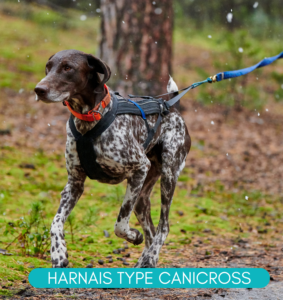
- The traction harness (sports): looks like the car harness, without the padding on the chest. The attachment for the leash is done on the back.
- The walking harness: presents flexible bands, with several adjustement points and without padding on the chest. The attachment point is at the front at the level of the dog’s chest.
A dog can therefore have more than one harness depending on the activities performed and can, with training, adapt to different models.
In order to have a better control of your dog when walking, it is essential to opt for a harness with a front attachment. This is moreover what is used in educational mode to improve the dog’s attention towards its guardian. In addition, it is important to ensure the proper fit and model choice of the harness on your dog to avoid musculoskeletal injuries or significant discomfort for your canine companion.
Here is what to look for when adjusting and fitting;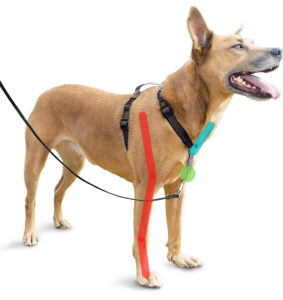
- The bones of the front leg are completely free (area in red on the picture).
- The dog’s trachea and sternum are covered, which means that when the dog pulls, the support is placed on the sternum bones and does not strangle the dog. In this way, when the dog pulls, it’s its entire rib cage that is held back (area in blue on the picture).
- The harness should have a fastening loop at the front that allows you to install your dog’s identification medallion, and attach your leash in order to create an anti-traction action (area in green on the picture).
Halter or harness: Golden rules!
- It is absolutely essential to be able to do the fitting in store to ensure that the model suits your dog well. Ensure the quality of the materials used, the assembly, and the adjustement options. It is also good to encourage local purchasing!
- Keep in mind that neither of these two tools will teach your dog to better manage his emotions nor to demonstrate better self-control. They can certainly help, but if you wish to work on your dog’s behavior, we strongly suggest that you take courses, or the advice of a canine behavior intervene member of the RQIEC professionals.
- Make sure to take the time to properly introduce this new tool to your dog. It is normal that at first your dog is disturbed by the presence of the harness or halter. Use positive reinforcement (treats) regularly to create a positive association with the presence of new equipment.
We have for sale at the boutique of the SPA de l’Estrie some of the models listed above. However, if you wish to learn about all types of harness or halter on the market, we recommend you to visit a pet shop near you!