
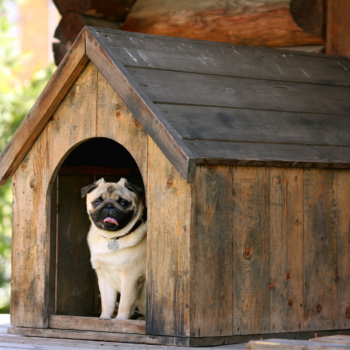
Dogs living outdoors need an adequate environment that will allow them to fully adapt to this lifestyle.
First of all, a well-designed kennel is an essential for a good quality of life. Whether you make it yourself or buy it ready-made, the kennel must meet specific needs.
The size of the kennel is very important. Many people make the mistake of building a kennel so large that the animal cannot retain its body heat, which is generally sufficient to warm it. So unless the kennel is heated, it must not be much larger than the animal itself. It must be just high enough for him to sit on without his head touching the ceiling and just large enough for him to lay comfortably. Remember that a kennel is a place to sleep and not to play.
As the kennel will be exposed to the weather, it must be built in a resistant material. Such as, for example, waterproof plywood with a thickness of at least half an inch (1.3 cm). It is essential that the walls and the roof of the kennel are well sealed in order to withstand the wind and water. In addition, provide a vestibule so that the dog is well protected from the cold. You can also place joints and metal corners (steel or aluminum) to prevent the dog from chewing or damaging its kennel. It must be installed in the shade and away from the wind. When the kennel is finished, treat the wood with a lead-free exterior varnish or paint to avoid any form of poisoning for the animal.
Kennel characteristics
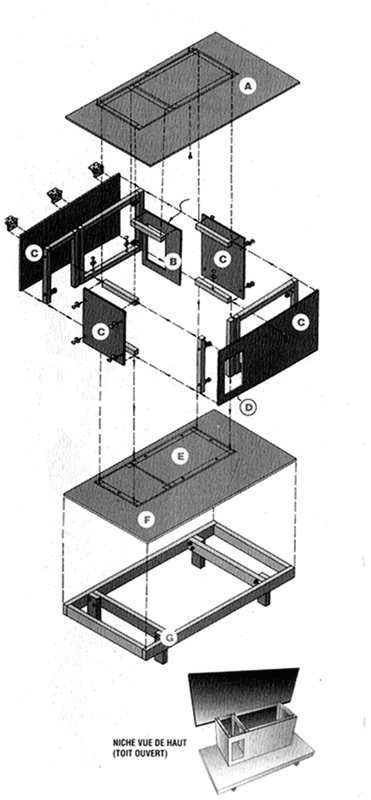
A. Reversible roof with a slight slope forming a canopy. It is recommended to paint the roof black on one side to allow reflection of sun rays in summer. Removable, the roof also facilitates cleaning of the kennel.
B. Removable partition that can be removed during hot weather, promoting air circulation.
C. Wall fixed to the floor with bolts that facilitate dismantling when one wants to change the recess.
D. Threshold with a minimum height of three inches to mitigate drafts in cold weather. In winter, a thick canvas can be added to the entrance of the kennel so that it keeps more its heat.
E. Wooden floor allowing better to keep the heat and drying quickly.
F. Platform on which the dog can extend above the floor.
G. Frame and supports releasing the kennel six inches above the ground to allow air circulation and keep the kennel dry.
*If your dog is hesitant to enter its kennel because of the darkness, raise the roof and let it explore its “house” during the day.
Kennel dimensions:
1. Surface du plancher:
Allow 36 square inches (225 cm²) of floor area for each inch (2.5 cm) of height between the ground and the dog’s shoulders. For example, a dog with a height of 20 inches (50 cm) needs an area of 720 squares inches (0,45 m²), or 20 inches (50 cm) x 36 inches (91 cm).
2. Hauteur:
To determine the height of your kennel inside, add one or two inches (2.5 or 5 cm) to your dog’s height when seated (from the top of his head or the tips of his ears, as appropriate). Thus, for a dog measuring 23 inches (58 cm) in this position, a kennel approximately 25 inches (64 cm) high is sufficient.
3. Other parts of the kennel:
Opening: 9’’ x 15’’ (23 cm x 38 cm)
Entry: 12’’ x 20’’ (30 cm x 50 xm)
Bedroom: 36’’ x 20’’ (91 cm x 50 cm)
Total interior area: 48’’ x 20’’ (122 cm x 50 cm)
Platform: 36’’ x 72’’ (91 cm x 183 cm)
Area: 36’’ x 72’’ (91 cm x 183 cm)
4. Assembly of the kennel:
• Nail the platform in plywood
of ½’’ on a frame of 2’’ x 4’’
• Fix the frame on legs of 2’’ x 4’’ x 10’’
• Nail ½’’ plywood walls
on frames of 2’’ x 2’’
• Assemble the walls with bolts
• Fix the walls to the platform with bolts
• Fix the hinges on the back wall using screws
• Secure the roof to the hinges using bolts