In recent years, our society has made great strides in promoting animal welfare and the recognition
The summer season remains a critical period for animal welfare organizations. However, one area still too oftens seems to escape the attention of the public and decision-makers: the exploitation of animals for entertainment purposes. This is particularly the case for rodeos.
For their followers, rodeos represent much more than a simple sporting discipline: they are perceived as a living cultural tradition, a symbol of collective identity and a moment of community gathering. Their economic impact is significant: they attract a large audience, boost the tourism industry and support several keys sectors in rural areas. For some municipalities, these activities are even crucial to the economic vitality of the territory.
However, rodeos are increasingly being questioned, particularly because of the practices they showcase and their consequences on animal welfare. For animal right defenders, rodeos represent a form of abuse disguised under the appearances of tradition. Several tragic incidents in recent years have reinforced this perception and fuelled debates.
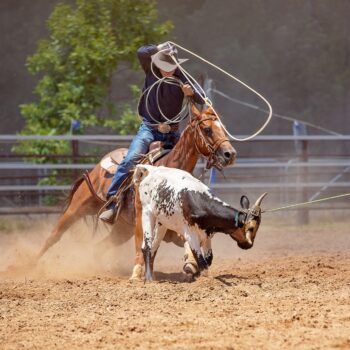
During the 2024 edition of the Festival western de Saint-Tite, a steer tragically lost his life during the steer wrestling test, sparking outrage. Nationally, the Calgary Stampede, one of the largest rodeo events, was also the scence of tragedies. In 2024, a steer and two horses died there during the steer wrestling and chuckwagons events. Another horse had to be euthanized following an injury sustained during a chuckwagons of the 2025 edition. Since 1986, 110 animals have died, numbers that illustrates the magnitude of the problem.
These facts raise a crucial question: in a society that is increasingly asserting the values of compassion, justice and respect for living beings, in their current form, still morally acceptable?
Our position
At the Société protectrice des animaux de l’Estrie, even though we recognize the importance of rural gatherings economically, communally and culturally, we are concerned about certain practices that are highlighted there.
We strongly believe that rodeos can and should evolve without to practices that inflict suffering, stress or injury on animals. Some trials go against the values we advocate today in terms of respect for living beings. They perpetuate an outdated vision of the relationship between humans and animals, based on domination and constraint rather than cooperation and mutual respect.
Our position is not a blind opposition to the rodeos themselves, but rather a call for thoughtful transformation of their practices. Completely banning these events would be neither fair nor constructive. On the other hand, reforming them to adapt them to a more ethical and contemporary vision of entertainment would be a responsible and balabced response.
We believe that it is entirely possible to preserve the festive, unifying and identity dimension of rodeos, while eliminating the most controversial events. Respectful alternatives, such as free dressage, aerobatics or demonstraions of complicity between humans and animals without the use of constraint, can offer an equally impressive show, but in harmony with modern values of kindness and empathy.
Reinventing rodeos in a more ethical way does not mean giving up tradition, but rather enriching it by integrating a more enlightened awareness of living beings. It is in this path of compromise and evolution that we invite organizers, decision-makers and the public to commit themselves, in order to build a future where culture and compassion coexist harmoniously.
Conclusion
In sum, even though rodeos occupy an important place in our regional heritage, it is becoming increasingly difficult to morally justify some of their practices in light of growing concerns about animal welfare. Faced with the suffering that certain trials inflict on animals, it is imperative to rethink these practices in light of the values of empathy and respect that guide our current society.
An evolution of rodeos is not only possible, but desirable: it would allow to preserve their festive and community essence while eliminating the most problematic elements. It is time to build a future where tradition and compassion coexist harmoniously.