
The first step is to inform us of the missing of your cat.
There’s two ways to notify us;
- By filling out an online report form here.
- By calling us during our business hours at (819) 821-4727 option 3.
Subsequently, it is necessary to immediatly undertake research in order to find him. The technique was developed according to peculiarities of feline behaviour. The effectiveness of this one in the field has already been observed many times.
Make search rounds.
During your rounds, have in hands food that he enjoys (tuna, treats, etc.). The smell could attract your cat to you. The cat lives in a world of familiar smells and sounds.
When he strays, he loses his bearings. His reflex is then to hide very close to the place from which he fled. It is therefore necessary to first look for him in those surroundings.
The cat that has run away often spends the first 24 hours of his fugue under a gallery, a staircase, a vehicule, or any other hiding place it will have found. As he is not limited in his movements by fences and streets, your research must therefore extend to the immediate vicinity, possibly including the sheds inside which he could have been inadvertently locked.
To be successful, search rounds must be frequent and conducted when all is quiet outside.
In the morning: around 4 am, 6:30 am and 7:30 am.
In the early evening: take this opportunity to go around the immediate neighborhood (gardens, yards, undercarriages), addressing your neighbors as well as people who walk their dog, and who normally do a walk twice a day.
In the evening, before the sun sets: then go around the back yards of the neighborhood (by asking permission).
How to call your cat during your research?
Call your cat from the furthest point of circle of your searches exclusively inward; otherwise, he risks moving even further away from the place where he was lost. In other words, during your rounds, call your cat when you get closer to your starting point, and not when you move away from it.
Call your cat by his name, out loud. Make sure your tone is playful (and not panicked) so that your cat feels reassured.
Wait patiently and observe if you detect movement; do not go too fast to allow your cat to approach you.
Some experts recommend calling him for 5 minutes straight, every half hour, and this, for 3 hours.
Inform your neighborhood.
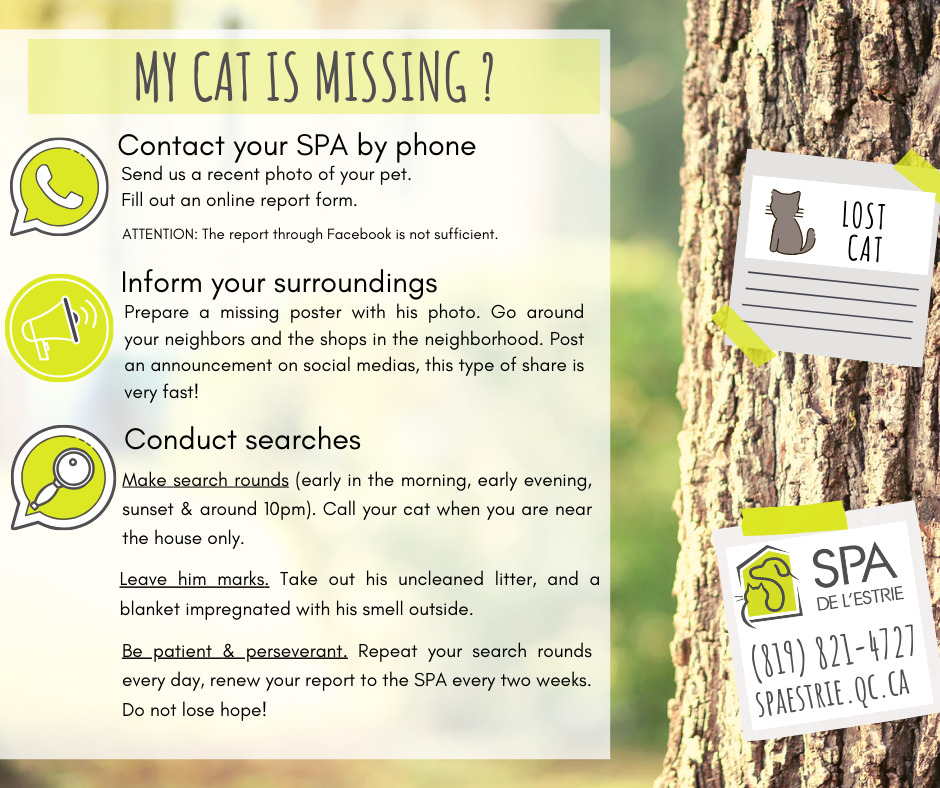
Create a missing notice with the following information;
- Recent photo of your pet; ideally where a distinctive sign is clearly visible so that someone can easily recognize him.
- His name & his age.
- Date on which he disappeared, and in which sector was he last seen.
- Your name and contact information (telephone, cellphone, email).
Distribute this card all over your neighborhood and talk to your neigbors. You can also display your missing cat notice in certain public places or businesses in your neighborhood.
At night, give your cat landmarks.
Every night, leave his uncleaned litter outside as well as a box filled with a blanket impregnated with his scent; also drop food and water.
Show perseverance and patience!
Repeat your search rounds every day, at fixed times, for a minimum of ten days; this exercise should last long enough for your cat to hear you and understand that your calls are repeated. Your cat will probably hear you in your first round, but won’t move. Over the next few days, he should identify where your voice comes from and try to get closer as soon as he understands that he can rely on your voice to reorient himself.